Monday, March 29, 2010

Experts hack iPhone SMS database in 20 sec


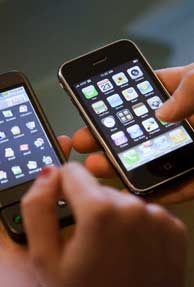
Two security researchers have found an exploit to hack iPhone's SMS Database in 20 seconds, while displaying their skills at the Pwn2Own contest at the CanSecWest Security show. Ralf Philipp Weinmann of the University of Luxembourg and Vincenzo Iozzo of German company Zynamics found this exploit for the iPhone that won them $15,000 prize, reported ZDNet.


iPhone was not the only thing to get hacked. Safari on Snow Leopard and Internet Explorer 8 as well as Firefox browsers on Windows 7 got hacked too, according to TechTree. Weinmann and Iozzo collaborated to finding vulnerability and then writing an exploit - the entire process took two weeks. As a part of the hack, iPhone users have to visit a website hosting malicious code and then steal iPhone's SMS database - all in the matter of 20 seconds! Weinmann explained, "Basically, every page that the user visits on our [rigged] site will grab the SMS database and upload it to a server we control".

Thomas Dullien, Weimann's colleague explained that the attacker had potential to do more damage without leaving the iPhone Sandbox, a tightly-controlled set of resources for running unverified codes. The exploit was written to bypass the digital signatures for verifying if the code in memory is from Apple or not. Weinmann pointed out that there's a non-root user called 'mobile' with certain user privileges and using that exploit, he could can do anything that 'mobile' (non-root user) can do.

Charlie Miller, principal security analyst at Independent Security Evaluators, found an exploit to hack Safari on a MacBook Pro without physically touching the machine and won $10,000 worth prize money.

Thursday, March 25, 2010

Scientists develop laser security for Internet

Scientists at Tel Aviv University have developed a new security system for Internet using a special laser that will help in keeping hackers' prying eyes off for good. It is developed using fiber optic and computer technology that transmits binary lock-and-key information in the form of light pulses.

Dr. Jacob Scheue, who came up with this device, said that a shared key code can be unlocked by the sender and receiver, and absolutely nobody else. "Rather than developing the lock or the key, we've developed a system which acts as a type of key bearer. The trick is for those at either end of the fibre optic link to send different laser signals they can distinguish between, but which look identical to an eavesdropper."


Adding to that, he said, "We've already published the theoretical idea and now have developed a preliminary demonstration in my lab. Once both parties have the key they need, they could send information without any chance of detection. We were able to demonstrate that, if it's done right, the system could be absolutely secure. Even with a quantum computer of the future, a hacker couldn't decipher the key."

500 Million Wi-Fi enabled handsets to ship in 2014

The ubiquity of both Wi-Fi technology and advanced mobile phones are ushering in a new age for people who want a high-performance multimedia experience at their fingertips. Carriers, handset makers, and end users are embracing Wi-Fi on the handset for its coverage benefits, bandwidth boost, and wide availability. New data from ABI Research indicates that out of approximately 580 million Wi-Fi devices shipped in 2009, 141 million were handsets.


The momentum of Wi-Fi enabled handsets reflects the recognition of the rigorous Wi-Fi CERTIFIED testing program from the Wi-Fi Alliance. Wi-Fi handset certification volume grew 142 percent in 2009 from 2008 levels. To date, more than 500 different handset models are now Wi-Fi CERTIFIED, giving consumers more choices than ever before.

"The phenomenal growth of handsets offering Wi-Fi is no surprise. Carriers and manufacturers have come to know Wi-Fi as a reliable, high-performance technology that's been independently validated in our renowned certification program. The Wi-Fi CERTIFIED program helps ensure a seamless user experience when using Wi-Fi-enabled mobile phones," said Edgar Figueroa, CEO of the Wi-Fi Alliance.

ABI Research expects this growth trend to continue, forecasting that half a billion Wi-Fi enabled handsets will ship in 2014, with 90 percent of smartphones incorporating Wi-Fi. "In the age of data-centric multimedia phones, carriers have embraced Wi-Fi technology as a way to offload traffic from licensed spectrum and improve the consumer experience. We are seeing handset users starting to demand Wi-Fi because of its higher data rate and indoor reception benefits," said Michael Morgan, Industry Analyst, ABI Research.

The next major technology advancement for handsets is on the horizon -- advanced Wi-Fi CERTIFIED n technology is beginning to appear in mobile phones, offering consumers increased coverage. The Wi-Fi CERTIFIED n program incorporates a broad range of performance features required to meet market needs in a wide range of applications.

The first ten Wi-Fi CERTIFIED n handsets have been announced, and given the benefits of this next-generation Wi-Fi technology compared to older generations, the migration toward 802.11n is expected to continue. ABI Research predicts that by 2012, 802.11n will be the predominant Wi-Fi technology in handsets.

Initial handset implementations of Wi-Fi CERTIFIED n technology will offer consumers greater effective ranges and improved coverage. Since data transmissions are more efficient with Wi-Fi CERTIFIED n, there is a lower impact to battery life compared to older forms of Wi-Fi technology. Enterprise IT managers will appreciate that Wi-Fi CERTIFIED n networks have greater capacity than legacy networks, allowing more users to be supported on a single network node.

Wi-Fi CERTIFIED n devices also incorporate WMM (Wi-Fi Multimedia) Quality of Service. WMM prioritizes network resources for voice and video applications to improve the performance of real-time applications. All Wi-Fi CERTIFIED devices are also tested to ensure that they support advanced WPA2 security capabilities.

Recognizing the need for handsets to be aligned with Wi-Fi industry standards for interoperability, security, easy installation, and reliability, the Wi-Fi Alliance began including mobile phones in its Wi-Fi CERTIFIED program in 2003.
One third of U.S. to be covered by 4G in 2010

Verizon plans to launch its 4G LTE network in Alabama, Georgia, and Minnesota according to announcements made at CTIA Wireless 2010. The company announced that it will be using U.S.Carrier Telecom to supply backhaul services to backhaul links to LTE cell sites to build the first 4G LTE networks in Georgia and Alabama.


"We are thrilled to help Verizon Wireless launch and grow its LTE offering in portions of Minnesota. As the wireless industry switches from T-1s to Ethernet backhaul, we are proud to work through the migration with a leader such as Verizon Wireless. The bandwidth that TTM is now deploying at each LTE cell site will enable Verizon Wireless to seamlessly scale and meet the dramatic growth in consumer data consumption," said TTM's Chief Executive Officer, Lynn Refer.

The carrier's Chief Technology Officer Tony Melone expects that the 25 to 30 cities launching in the "not too distant future" would be enough to cover a third of the U.S. by the end of the year. Coverage should double in about 15 months and should finally match or exceed 3G by late 2013.

U.S.Carrier is utilizing the most advanced Dense Wave Division Multiplexing (DWDM) transmission over its high-capacity optical transport network and will supply backhaul links between major Verizon Wireless switch centers throughout Georgia and Alabama. Additionally, U.S.Carrier is coordinating efforts with Verizon Wireless partners to aggregate cell tower traffic to major switch centers. "Verizon Wireless has been one of U.S. Carrier's most prominent customers since 2004," said Joaquin Luna,President of U.S.Carrier Telecom. "Because of the increased demand for mobile data traffic, U.S.Carrier is dedicated to staying in the forefront of network technology as we continuously upgrade our core network to help deliver the most innovative, cost-effective 3G and 4G services available to Verizon Wireless."

Wednesday, March 10, 2010

Is Internet access a fundamental right?

A recent study proposes that a many adults view Internet access as a basic right, and a significant portion believes it should not be regulated.

As reported by Reuters, the global survey for the BBC World Service showed that four out of every five adults maintain the view that web access is a right, and many survey respondents view it as a source of freedom for expressing their views, etc.


Doug Miller, Chairman of survey conductor GlobeScan said, "Despite worries about privacy and fraud, people around the world see access to the Internet as their fundamental right. They think the Web is a force for good, and most don't want governments to regulate it."

BBC quizzed more than 27,000 adults across 26 countries, and found that 87 percent of browsers believed Internet access should be the "fundamental right of all people". The survey also found significant number of supporters in favour of net access on both sides of the virtual divide, with those in South Korea forming the majority (96 percent) in supporting the idea, the BBC reported.

Even respondents in Japan, Mexico and Russia confessed that they could not live without the virtual world. Most of the users in Japan, South Korea and Germany also said that they were afraid to express their opinions safely online, while those in Nigeria, India and Ghana were much more confident about speaking out.

Google, Dish test TV search service

To help users in getting content from television and the web, Google and U.S. satellite TV operator Dish Network are testing a television programming search service.

The report published in The Wall Street Journal said that the service, which runs on TV set-top boxes containing Google software, allows users to find shows on the satellite TV service as well as video from websites like YouTube. It also allows users to personalize the line-up of shows.


With this step, Google e3ntered into a group of companies, which have been trying for years to marry the web and TV and their business models - from rivals Microsoft and Apple to the makers of TV and set-top boxes.

Besides Dish Network, Google is also in touch with a range of other television service providers and hardware makers, prodding them to use its Android-based technologies to offer a broader range of programming, a more personal experience and ads.

Mobile phones to offer X-ray vision

Researchers at the University of South Australia with the collaboration of Nokia have come up with software, which will offer X-ray vision to see what's on the other side of the building, reports ANI.

Talking to Sydney Morning Herald, Christian Sandor, Researcher at University of South Australia, said that the application works by using the phone's camera. Users can point the camera at a building and an image of it would appear on the screen. Then, the image would change to show what was behind the building, as if it was no longer there.


The application is likely to be introduced in the market in the next two years. The technology, known as augmented reality, appears to be X-ray vision, but in reality it uses pictures and images that already exist in databases such as Google Earth and Google Streetview.

Explaining the usage of application, Sandor said, "The application needs two pieces of information: 3D model of the area or city the phone user is in and the user's exact position. A 3D model of a city could be built using information collected from aerial surveys." He also said that the technology could not be used to see into people's houses because only the exterior views of buildings and streets were held in the databases.